Sunday, January 15, 2012

A shy and hidden bird


In the swamp, in secluded recesses,
A shy and hidden bird is warbling a song.

Solitary, the thrush,
The hermit, withdrawn to himself, avoiding the settlements,
Sings by himself a song.
- Walt Whitman, in When Lilacs Last in the Door-yard Bloom’d (Leaves of Grass)


Because my first and only other sighting of it some weeks back had been rather brief, I was thrilled to have a long and close look at the aptly-named Hermit Thrush today at the Sepulveda Basin Wildlife Reserve.

I had no idea how famous it is in American poetry. Besides the above quote, consider the following:


Friday, January 13, 2012

in with the new...

I wrote a long post for this blog after the new year and my screen froze, so it was all wiped out. Sigh.

Anyway, the short version is that I was reporting on a few birding trips:

* A new year's eve trip to Antelope Valley, a trip lead by Louis Tucker, focused on identifying Raptors. I got to sit in a car with experienced birders (with 20 and 30 years of birding experience each, respectively) and listen with rapt attention as they talked about their passion. I got to see all kinds of raptors (including Northern Harrier, Rough-legged Hawk) and other interesting birds including the Greater Roadrunner and California Quail. Another highlight of this trip was meeting a 9 year old who has seen close to 200 species already over the past six months that he has been birding. This made me resolve to involve my little ones more in  bird-watching this year...

* On Jan 2, I participated for the first time in the annual Christmas Bird Count organized by the Audubon Society, at Hahn Park, joining Eric and Ann Brooks, local experts. New sightings for me included the Peregrine Falcon, House Wren and Bewick's Wren.


* These are pictures of Rose-ringed parakeets we found at the Del Rey Lagoon. Seeing them felt somehow magical, because I re-connected to something forgotten from my childhood. These are birds I grew up with more than two decades ago in India. I remembered that they used to eat up nearly all the fruits in the Guava tree behind my house, before they could ripen, much to our frustration. And I remembered how their loud but not entirely unpleasant squawking filled the evening air as they roosted in large numbers.


(Photos by Zhen Krishnamachari)

***

I came across a nice birding blog today, by the poly-lingual Tom Miko, titled the "The Pro-Nuclear Birder":
http://radioactivebirdwatcher.blogspot.com/

This made me plan to compile a list of blogs by birders...

Friday, December 30, 2011

Rara Avis!


I was returning back from taking out the trash this morning and heard a clear "chip" in the tree above me. Thinking it was probably a yellow-rumped warbler (which are rather plentiful around here), I looked up casually. What I saw made me freeze: high up on the tree was a bird with black and white markings on its face like I had not ever seen before. I stared at it a bit, but felt unsure that I'd be able to identify it later because of how far away it was. So I raced back home to pick up my binoculars and a camera. 

Luckily, it was still there when I got back. I took as many photos as I could and stood there a while observing the pretty little thing flit from branch to branch and tree to tree, all the while continuing to "chip" away. 

When I got back home, I checked two different field guides to confirm what I was seeing. It looked quite definitively to me like the yellow-throated warbler. This warbler (Setophaga dominica) comes in two main varieties/subspecies: white-lored or yellow-lored. What I had seen was a yellow-lored one. 

However, there was one troubling issue. According to both books I was consulting as well as online sources, this bird is not really supposed to be seen in this part of the country, being primarily a bird of the southeastern USA. I found only one report of this bird in the LA area, dating back to May 2007. I also discovered that it is considered a statewide rarity for California.


So I sent my pics to Mr. Kimball Garrett, the Ornithology Collections Manager at the LA County Natural History Museum, a very well known and accomplished birder in this area. To my delight, he wrote back, confirming my identification, with the words: "Yes, this is certainly a Yellow-throated Warbler -- nice documentation of one of the few winter records for coastal southern California." And another local birding expert that I consulted on the pics wrote: "It might start a small stampede if the bird's location was known!"


It was beginner's luck, no doubt, but I am on cloud nine. What a wonderful way to cap the year!

Thursday, December 29, 2011

Bird-being

Breathtaking.

The Human Flamingo

By Gesine Marwedel, Photo by Thomas van de Wall, November 2011.

Wednesday, December 28, 2011

To pish or not to pish

What are the tools of a bird-watcher? It is easy enough to come up with a list: binoculars / scope, field guides, notebooks, perhaps a GPS device...

But one of the more unusual tools in the birders arsenal is not a physically tangible object at all. It is "pishing", which refers to the act of making bird-like sounds, specifically, a soft "pish"-like sound,  to attract birds. 


In the above video, American naturalist Pete Dunne demonstrates how to do pishing and make other bird calls.

The first time I heard a birder do this recently on an LA Audubon society-led bird-watching trip, I was a bit skeptical. But the literature shows it really does work! Consider these two papers:

[1] J. R. Zimmerling and C. D. Ankney, "A Technique that increases detectability of passerine species during point counts", Journal of Field Ornithology 71(4):638-649, 2000.

The abstract of this paper starts out with:
During April–July 1997, we censused birds in three woodlands near Arnprior, Ontario, Canada using conventional point counts (n = 12) and point counts supplemented with “pishing” (n = 12), a well-known method for attracting various bird species. Overall, 3.6 (19%) more species were detected per census using pishing. Irrespective of statistical significance of individual species, 45 (74%) of the 61 species were detected on more days using pishing, whereas 5 (8%) species were detected on more days using the conventional method. A higher number of males and a higher number of visually detected species were recorded using pishing as compared to the conventional method, and these differences did not change with date. 
And the following paper by Langham et al. presents a hypothesis for why pishing works, based on the similarity of pishing to the scolding sounds of Titmouse:


***

There is, of course, an ethical issue that arises here. Is it really ok for a birder to, well, deceive birds into showing up? How much does it affect birds as they go about their everyday routines to respond to a false alarm?

The American Birding Association's code of ethics advises birders to "limit the use of recordings and other methods of attracting birds, and never use such methods in heavily birded areas, or for attracting any species that is Threatened, Endangered, or of Special Concern, or is rare in your local area." It also adds "if you are attracting birds to an area, ensure the birds are not exposed to predation from cats and other domestic animals, or dangers posed by artificial hazards."

(Come now, don't laugh! This is a serious matter. Banish that vision you just conjured up, of Silvester using pishing to lure little Tweety bird.)

***

Anyway, the next time you see someone on a hiking trail making strange shushing sounds at no one in particular, please don't shake your head thinking "poor demented chap." It might just be me.

Monday, December 26, 2011

Growing the list

When you first start birding, or, as in my case, resume after a long gap in a new place, the identification of new birds ("lifers" as they are called by bird-watchers) occurs with gratifyingly high frequency. I have only about 60 birds on my list so far, and it's enjoyable to watch that list grow steadily.


American White Pelican


White-faced Ibis

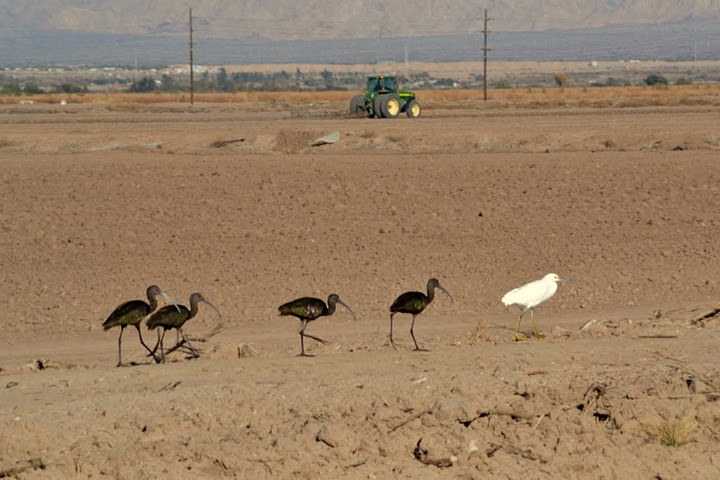
From this perspective, the trip to Salton Sea was wonderful. I saw about thirty birds, many of them new to me. These included American White Pelican, Eared Grebe, Bonaparte's Gull, Least Sandpiper, White-faced Ibis,  Cattle Egret, Abert's Towhee, Tree Swallow.

Following the leader 

What you often remember about a bird is the setting you saw it in the first time. I hope I won't forget the sight of more than 50 cattle egrets in the fields near the lake, that comedic group of four iridescent white-faced ibises strutting in a line behind a snowy egret who seemed puzzled at this newly-acquired band of followers, turning back to look at them nervously from time to time, the freedom of the tree swallows conducting aerobatics in the evening light...

Dead Tilapia litter the "sands" of the Salton Sea beach

I must record that the Sea itself seemed a little less bleak than I had expected from all the videos and descriptions on the web (see my previous post). Then again, most of those articles and videos were describing what this place feels like in the summer, which must be quite different with its oppressive heat and pervasive smell of decaying fish. On this winter weekend, the beach was indeed unusual because it consisted entirely of the broken bones of dead fish and there were skeletal remains strewn about everywhere, but the weather was extremely pleasant, the smell was not too terrible, and the water was vast and calm.

Mudpots look like mini-volcanoes
Bubbling mud inside


There were many interesting sights and sounds near the sea, immense stretches of cultivated fields, a fully camouflaged hunter I mistook for a bush until he moved, the occasional report of hunting rifles. On Davis road, not far from the wildlife refuge center, we came across an interesting field of many bubbling mud-pots. The hot mud squirting and oozing from them formed conical  shapes 3-5 feet tall, looking rather like miniature volcanoes.


A geothermal plant near the Salton Sea


In fact, the area is full of geothermal activity, and there are several operational geothermal power plants there, in which water is injected underground and is turned into steam by the heat, powering turbines to generate electricity. A fully renewable energy source, most common in Iceland. Seeing it here brought back  long-forgotten memories of a high school science fair project, of sultry afternoons in a dark room where I worked with classmates to build a model of such a plant.

As we drove back, the setting sun silhouetted the mountains to the west in a beautiful shade of blue, and the many-hued sky yielded alternately bright and dark and glimmering reflections in the water.

***


Feeding our morning visitors  

A simpler pleasure is a close encounter with birds. On Saturday, my younger son was delighted to find a pair of Mallards, a male and a female, at the back door of the rooms where we stayed. He fed them some bread, thrilled that they stood trustingly inches away from him. We examined them closely, counting their toes and noting the webbing (which my son referred to as "flippers"). The next morning, at the same time, we pushed back the curtains to see that they were not only back, but they had invited their closest friends to join them for the Christmas breakfast. Both couples fed on bread and shuffled silently away.

***

Lake Perris
  
On the way back we stopped by to picnic at Lake Perris, a nice stretch of water in San Jacinto, only a little over an hour away from L.A. We passed by large dairy farms on the way there. One of these had a large patch of standing water where hundreds of Ring-billed Gulls had alighted, along with a few delicate Black-necked Stilts. By the lake, I got a good look at a Cassin's Kingbird, which too I had not seen before.

(Photos courtesy: Zhen Krishnamachari)

Saturday, December 24, 2011

Post-apocalyptic wonderland


The Salton Sea has been called a post-apocalyptic wonderland. A weirdly beautiful landscape shaped by a man-made inland lake (California's largest!) filled with salt (saltier than seawater) that once was called the "Riviera of the West" and is now a place of ghost towns, abandoned by humans and full of dead and decaying fish.

I am now in Palm Springs, waiting for the kids to wake up and have breakfast so we can head over to this place about an hour south of here.

Why are we here? What the above descriptions and the video documentary don't bring out is that the Salton Sea is also considered one of the best places to look for birds in California. Right on one of the main migratory highways, it is said to be host to nearly 400 species of birds over the course of each year.

The pure desert air outside is chilly and crisp. I'm excited.